English
 Arabic
 French
 Spanish
 Portuguese
 Deutsch
 Turkish
 Dutch
Dutch
 Italiano
 Russian
 Romaian
 Portuguese (Brazil)
 Greek
Greek
The Diplomat' Season 2 – Plot Twists Revealed
Games |
2025-12-27 00:44:13
The Volumetric Display Market is emerging as one of the most transformative segments within the advanced visualization and display technology landscape. Unlike conventional 2D or stereoscopic 3D displays, volumetric displays create true three-dimensional images that occupy real physical space and can be viewed from multiple angles without the need for special glasses or headsets. As industries increasingly demand immersive, data-rich, and intuitive visualization tools, volumetric display technology is gaining significant traction across healthcare, automotive, aerospace, defense, entertainment, and scientific research sectors.
Volumetric displays generate images by illuminating points in a three-dimensional space, often referred to as voxels (volumetric pixels). These voxels form a visible 3D object that appears to float in mid-air or within a transparent enclosure. Unlike flat-panel displays or holographic projections that rely on optical illusions, volumetric displays present physically accurate depth, enabling users to walk around and view the image from different perspectives naturally.
Several core approaches dominate volumetric display development, including swept-volume displays, static volume displays, and light field-based systems. Swept-volume displays rely on rapidly moving components such as rotating screens, while static volume displays use solid-state materials or layered optical elements. Each technology type has unique performance characteristics in terms of resolution, brightness, scalability, and cost, shaping adoption across different end-use applications.
Uncover strategic insights and future opportunities in the Volumetric Display Market. Access the complete report:
https://www.databridgemarketresearch.com/reports/global-volumetric-display-market
One of the primary drivers of the volumetric display market is the growing need for immersive visualization solutions. Industries handling complex spatial data—such as medical imaging, engineering design, and scientific modeling—require visualization methods that enhance depth perception and spatial understanding. Volumetric displays allow professionals to analyze intricate structures more intuitively, improving decision-making and reducing errors.
Continuous innovation in optics, microelectronics, laser systems, and computing power has significantly enhanced volumetric display performance. Improvements in voxel density, refresh rates, and color accuracy are making volumetric displays more practical and visually compelling. At the same time, declining costs of core components are helping to bridge the gap between experimental prototypes and commercial-ready products.
Healthcare represents a major growth avenue for the volumetric display market. Surgeons, radiologists, and medical researchers benefit from realistic 3D visualizations of organs, tissues, and anatomical structures. Volumetric displays enable enhanced pre-surgical planning, real-time procedural guidance, and improved medical education. The ability to view complex medical data without wearing head-mounted devices is particularly appealing in sterile clinical environments.
The volumetric display market can be segmented into swept-volume displays, static volume displays, and light field displays. Swept-volume displays currently dominate due to their relative maturity and higher brightness levels. However, static volume displays are gaining momentum as advancements in solid-state materials enable more compact and durable designs. Light field displays, while still evolving, offer promising potential for high-resolution, scalable 3D visualization.
Applications of volumetric displays span a wide range of industries. In healthcare, they are used for diagnostics, surgical planning, and training. In aerospace and defense, volumetric displays support mission planning, simulation, and situational awareness. Automotive manufacturers utilize them for design visualization and advanced human-machine interfaces. Additionally, education, museums, and entertainment venues are increasingly adopting volumetric displays to deliver engaging, interactive experiences.
Key end users include hospitals, research institutions, defense organizations, automotive OEMs, academic institutions, and commercial enterprises. Research and defense sectors have traditionally led adoption due to higher budgets and specialized requirements. However, as technology matures and costs decline, commercial and educational users are expected to account for a growing share of market demand.
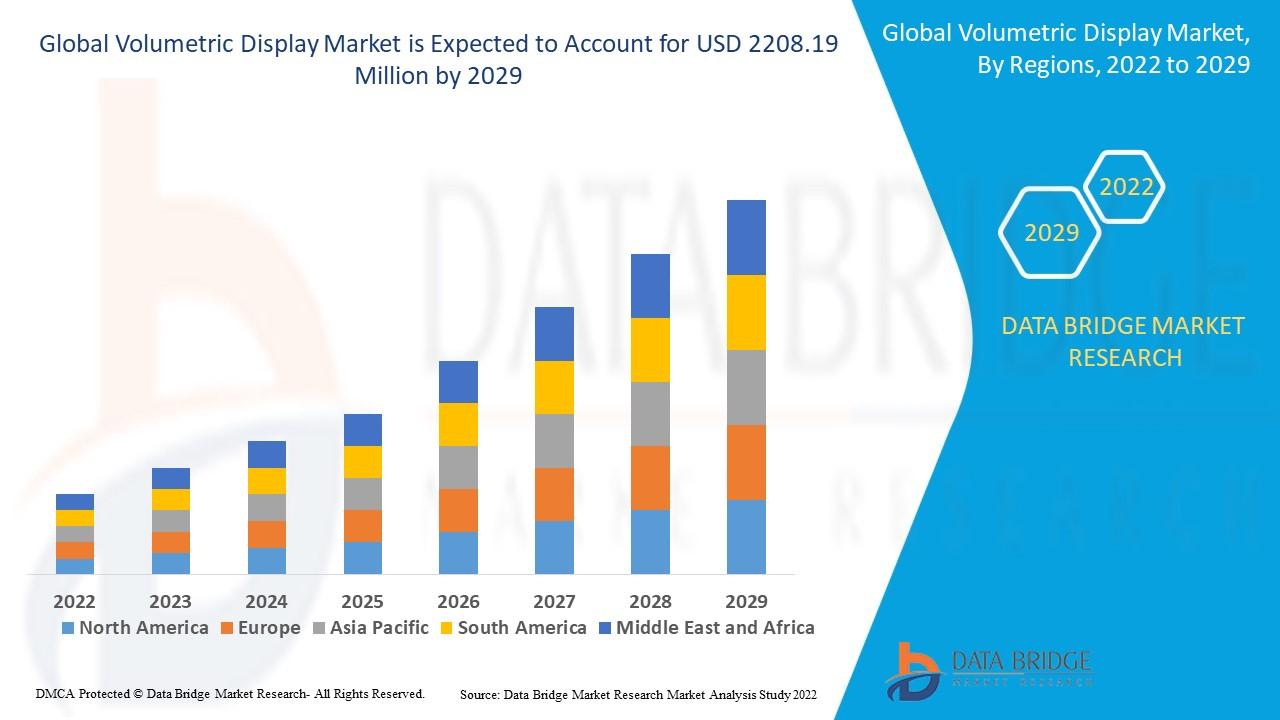
North America holds a prominent position in the volumetric display market, driven by strong investments in research and development, early adoption of advanced visualization technologies, and a robust presence of technology innovators. Europe follows closely, benefiting from a strong healthcare infrastructure and increasing use of 3D visualization in industrial and scientific applications.
The Asia-Pacific region is expected to witness the fastest growth over the forecast period. Rapid industrialization, expanding healthcare infrastructure, and increasing focus on smart manufacturing and advanced education tools are fueling demand for volumetric displays. Countries in this region are also investing heavily in next-generation display technologies, further accelerating market expansion.
The volumetric display market is characterized by intense innovation and ongoing experimentation. Market players are focusing on improving image resolution, expanding display volumes, and enhancing user interactivity. Integration of volumetric displays with artificial intelligence, real-time data analytics, and advanced sensors is emerging as a key trend, enabling more dynamic and responsive visualization environments.
Collaborations between technology developers, research institutions, and end users are becoming increasingly common. These partnerships help accelerate product development, validate real-world use cases, and refine system performance. Customization and application-specific solutions are also gaining importance as different industries demand tailored volumetric display capabilities.
Despite its promising potential, the volumetric display market faces several challenges. High initial costs, technical complexity, and limited content availability remain significant barriers to widespread adoption. Additionally, scalability issues and constraints related to brightness, resolution, and energy consumption can limit deployment in certain environments.
Another challenge lies in standardization. As volumetric display technologies continue to evolve, the lack of unified standards for content creation, data formats, and system interoperability can slow adoption. Addressing these issues will be critical for the market to transition from niche applications to mainstream usage.
The future of the volumetric display market appears highly optimistic. As technological advancements continue to address existing limitations, volumetric displays are expected to become more compact, affordable, and user-friendly. The convergence of volumetric visualization with emerging technologies such as artificial intelligence, digital twins, and advanced simulation platforms will further expand its application scope.
In the long term, volumetric displays have the potential to redefine how humans interact with digital information. From transforming medical diagnostics to revolutionizing product design and enhancing educational experiences, the impact of this technology will extend far beyond traditional display solutions.
The volumetric display market represents a significant leap forward in visualization technology, offering true three-dimensional imaging that enhances perception, interaction, and understanding. Driven by growing demand for immersive experiences, technological advancements, and expanding application areas, the market is poised for substantial growth in the coming years. While challenges related to cost, complexity, and standardization persist, ongoing innovation and cross-industry collaboration are steadily unlocking the full potential of volumetric displays, positioning them as a cornerstone of next-generation visual communication.
Browse More Reports:
Global Water Treatment Chemicals Market
Global Scented Candle Market
Global Ceramics Market
Europe Japanese Restaurant Market
Global Smart Fleet Management Market
Global Tuna Market
Global Tote Bags Market
Global Gemstones Market
Global Japanese Restaurant Market
Global Hypochlorous Acid Market
Global Toothbrush Market
Global Cataracts Market
Global Wire and Cable Market
Global Plant-Based Food Market
Global Tomatoes Market
About Data Bridge Market Research:
An absolute way to forecast what the future holds is to comprehend the trend today!
Data Bridge Market Research set forth itself as an unconventional and neoteric market research and consulting firm with an unparalleled level of resilience and integrated approaches. We are determined to unearth the best market opportunities and foster efficient information for your business to thrive in the market. Data Bridge endeavors to provide appropriate solutions to the complex business challenges and initiates an effortless decision-making process. Data Bridge is an aftermath of sheer wisdom and experience which was formulated and framed in the year 2015 in Pune.
Contact Us:
Data Bridge Market Research
US: +1 614 591 3140
UK: +44 845 154 9652
APAC : +653 1251 975
Email:- corporatesales@databridgemarketresearch.com