English
 Arabic
 French
 Spanish
 Portuguese
 Deutsch
 Turkish
 Dutch
Dutch
 Italiano
 Russian
 Romaian
 Portuguese (Brazil)
 Greek
Greek
Aircraft Couplers Market Growth Outlook: Trends, Opportunities, and Forecast
Other |
2025-12-15 11:25:25
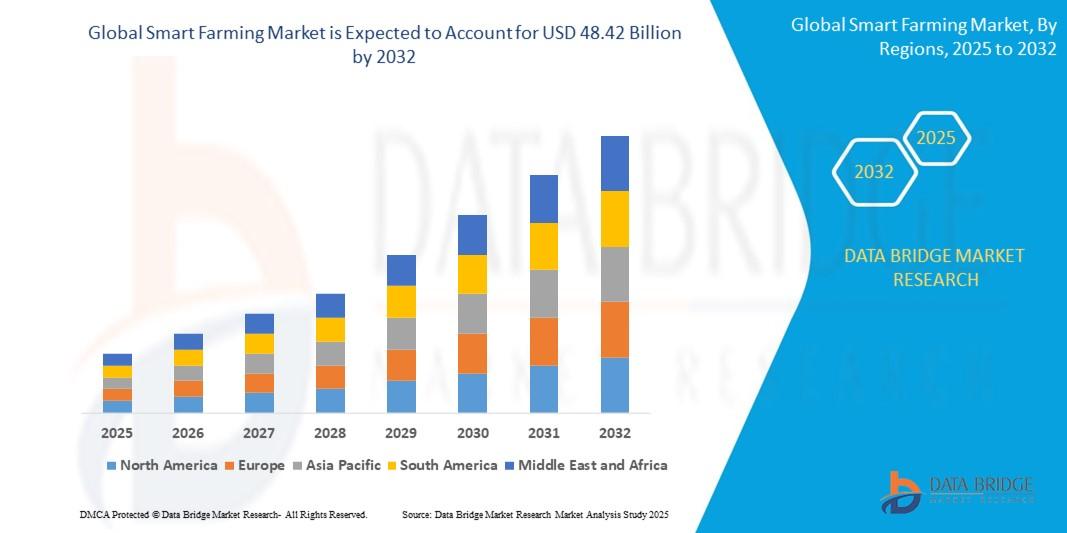
The Smart Farming Market is rapidly reshaping the global agricultural landscape by integrating advanced digital technologies into traditional farming practices. Also known as precision agriculture or digital farming, smart farming leverages tools such as the Internet of Things (IoT), artificial intelligence (AI), big data analytics, drones, GPS-enabled equipment, and automation systems to enhance farm productivity, sustainability, and profitability. As the global population continues to rise and pressure on food supply intensifies, smart farming has emerged as a critical solution for ensuring food security while optimizing resource utilization.
Smart farming enables data-driven decision-making across the entire agricultural value chain—from soil preparation and crop planting to irrigation, harvesting, and post-harvest management. This market is gaining strong momentum worldwide, supported by technological advancements, government initiatives, and growing awareness among farmers about the benefits of precision agriculture.
The smart farming market encompasses a wide range of hardware, software, and services designed to improve agricultural efficiency. These solutions allow farmers to monitor field conditions in real time, predict crop yields, reduce input costs, and mitigate risks related to climate variability and pests.
Modern agriculture is no longer solely dependent on manual labor and experience-based decisions. Instead, smart farming solutions provide actionable insights through sensors, satellite imagery, and analytics platforms. As a result, farms can achieve higher yields with lower environmental impact, making smart farming an essential component of sustainable agriculture.
Tap into future trends and opportunities shaping the Smart Farming Market . Download the complete report:
https://www.databridgemarketresearch.com/reports/global-smart-farming-market
IoT plays a foundational role in smart farming by connecting sensors, equipment, and systems across the farm. Soil moisture sensors, weather stations, livestock trackers, and smart irrigation systems collect real-time data that enables precise control over farming operations. IoT-based farming reduces water usage, minimizes fertilizer waste, and improves crop health monitoring.
AI and machine learning algorithms analyze vast volumes of agricultural data to provide predictive insights. These technologies help farmers forecast weather patterns, detect crop diseases early, optimize planting schedules, and automate decision-making. AI-powered image recognition is widely used for crop health assessment, weed detection, and yield estimation.
Agricultural drones are increasingly used for aerial surveying, crop mapping, and field analysis. Equipped with high-resolution cameras and multispectral sensors, drones allow farmers to identify problem areas quickly, monitor crop growth, and apply inputs precisely. Remote sensing technologies significantly reduce labor costs and improve operational efficiency.
Automation is transforming farm operations through autonomous tractors, robotic harvesters, and automated milking systems. These solutions address labor shortages, improve accuracy, and enable round-the-clock operations. Farm robotics is particularly valuable in large-scale commercial farming and high-value crop production.
Farm management platforms integrate data from multiple sources to provide a unified view of farm operations. These software solutions assist with inventory management, financial planning, compliance tracking, and performance optimization. Data-driven insights enable farmers to make informed decisions that maximize profitability.
The smart farming market is segmented into hardware, software, and services. Hardware includes sensors, drones, GPS devices, and automated machinery. Software comprises farm management platforms, analytics tools, and decision-support systems. Services include installation, maintenance, consulting, and data analytics support. Among these, software and services are witnessing rapid growth due to increasing adoption of data-centric farming models.
Key applications of smart farming include precision crop farming, livestock monitoring, smart irrigation, greenhouse automation, aquaculture management, and supply chain optimization. Precision crop farming dominates the market, driven by the need to increase yields while reducing input costs and environmental impact.
Smart farming solutions are adopted by small, medium, and large farms. While large-scale farms were early adopters due to higher capital availability, affordable and scalable solutions are now enabling small and medium farms to participate in digital agriculture.
One of the primary drivers of the smart farming market is the growing global demand for food amid shrinking arable land. Smart farming allows farmers to produce more with fewer resources. Climate change and unpredictable weather patterns are also pushing farmers toward technology-based solutions that improve resilience and risk management.
Government support and favorable policies promoting digital agriculture further accelerate market growth. Subsidies, training programs, and public-private partnerships are encouraging farmers to adopt smart technologies. Additionally, rising labor costs and workforce shortages are increasing reliance on automation and robotics in agriculture.
Despite its strong growth potential, the smart farming market faces several challenges. High initial investment costs can be a barrier, particularly for smallholder farmers. Limited digital literacy and lack of technical expertise also hinder adoption in developing regions.
Data security and privacy concerns are emerging issues as farms become increasingly connected. Interoperability between different technologies and platforms remains another challenge, emphasizing the need for standardized solutions.
North America is a leading region in the smart farming market due to early technology adoption, strong infrastructure, and high awareness among farmers. Europe follows closely, driven by sustainability-focused agricultural policies and advanced research initiatives.
Asia-Pacific is expected to witness the fastest growth, supported by rising population, increasing food demand, and government-led digital agriculture programs. Countries with large agricultural economies are investing heavily in precision farming technologies to improve productivity and food security.
Latin America, the Middle East, and Africa are also gradually adopting smart farming solutions, particularly in commercial farming and export-oriented agriculture.
The smart farming market is highly competitive, with a mix of established technology providers and innovative startups. Market players focus on product innovation, strategic partnerships, and expansion into emerging markets. Integration of AI, cloud computing, and advanced analytics is a key competitive strategy.
Companies are also emphasizing user-friendly platforms and affordable solutions to increase adoption among small and medium-sized farms.
The future of the smart farming market is strongly positive. Continued advancements in AI, edge computing, and 5G connectivity are expected to further enhance precision agriculture capabilities. Integration of climate-smart agriculture practices with digital tools will play a vital role in achieving sustainability goals.
As technology becomes more accessible and affordable, smart farming is expected to transition from a competitive advantage to a standard practice in modern agriculture. The market will continue to evolve, offering significant opportunities for innovation, investment, and long-term growth.
The Smart Farming Market represents a transformative shift in global agriculture, combining technology, data, and sustainability to address some of the most pressing challenges facing food production today. By enabling precision, efficiency, and resilience, smart farming solutions are redefining how farms operate across the world. With strong growth drivers, expanding applications, and continuous technological advancements, the smart farming market is poised to play a crucial role in shaping the future of agriculture.
Browse More Reports:
Global Water Treatment Chemicals Market
Global Scented Candle Market
Global Ceramics Market
Europe Japanese Restaurant Market
Global Smart Fleet Management Market
Global Tuna Market
Global Tote Bags Market
Global Gemstones Market
Global Japanese Restaurant Market
Global Hypochlorous Acid Market
Global Toothbrush Market
Global Cataracts Market
Global Wire and Cable Market
Global Plant-Based Food Market
Global Tomatoes Market
About Data Bridge Market Research:
An absolute way to forecast what the future holds is to comprehend the trend today!
Data Bridge Market Research set forth itself as an unconventional and neoteric market research and consulting firm with an unparalleled level of resilience and integrated approaches. We are determined to unearth the best market opportunities and foster efficient information for your business to thrive in the market. Data Bridge endeavors to provide appropriate solutions to the complex business challenges and initiates an effortless decision-making process. Data Bridge is an aftermath of sheer wisdom and experience which was formulated and framed in the year 2015 in Pune.
Contact Us:
Data Bridge Market Research
US: +1 614 591 3140
UK: +44 845 154 9652
APAC : +653 1251 975
Email:- corporatesales@databridgemarketresearch.com