English
 Arabic
 French
 Spanish
 Portuguese
 Deutsch
 Turkish
 Dutch
Dutch
 Italiano
 Russian
 Romaian
 Portuguese (Brazil)
 Greek
Greek
Robotic Vacuum Cleaner Market Scope, Segmentation, and Key Insights 2025–2032
Other |
2025-10-22 12:06:28
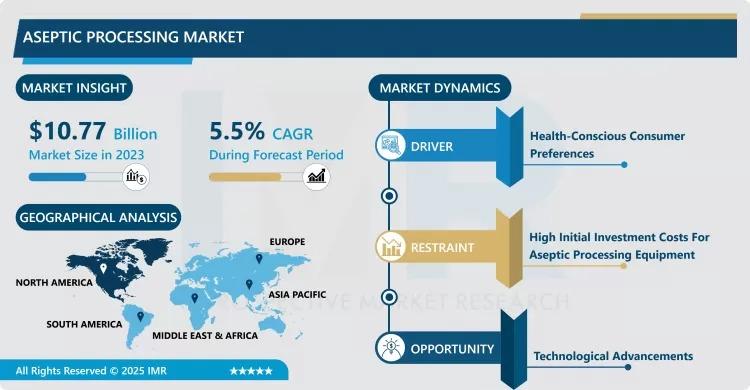
Aseptic processing is a sophisticated manufacturing technique where sterile products are packaged into sterile containers within a contamination-free environment. This method ensures that food, beverages, and pharmaceutical products remain shelf-stable at ambient temperatures without the need for refrigeration or chemical preservatives. By sterilizing the product and the packaging separately before they are brought together, aseptic processing maintains the organoleptic properties, nutritional value, and flavor of the contents far better than traditional thermal processing methods like canning.
The global market is witnessing a significant shift toward this technology as consumer demand for "clean label" and preservative-free products grows. In the food and beverage industry, it is essential for the production of juices, dairy products, and ready-to-drink (RTD) beverages. Simultaneously, the pharmaceutical sector relies heavily on aseptic processing for the production of sterile injectables, vaccines, and biologics, where even the slightest contamination can compromise patient safety. The technology’s ability to extend shelf life while reducing energy consumption in the cold chain makes it a cornerstone of modern sustainable manufacturing.
Market Segmentation:
The Aseptic Processing Market is segmented into Type, Material, and Application. By Type, the market is categorized into Packaging (Cartons, Bags & Pouches, Vials & Ampoules, Bottles & Cans, Others) and Equipment (Processing Equipment, Packaging Equipment). By Material, the market is categorized into Paper & Paperboard, Plastics, Metal, and Glass. By Application, the market is categorized into Food & Beverages, Pharmaceuticals, and Others.
Growth Driver:
Surging Demand for Preservative-Free and Clean Label Products The primary driver for the Aseptic Processing Market is the global consumer shift toward healthy, "clean label" products. Modern consumers are increasingly wary of chemical preservatives and artificial additives in their food and drinks. Aseptic processing addresses this by allowing manufacturers to achieve long shelf stability at room temperature while preserving the natural taste and nutritional profile of the product. This technology eliminates the need for refrigeration during transport and storage, significantly reducing costs and carbon footprints for manufacturers while satisfying the demand for fresh, natural, and convenient consumer goods.
Market Opportunity:
Expansion of the Biopharmaceutical and Vaccine Sector The rapid growth of the biopharmaceutical industry presents a massive opportunity for aseptic processing. With the increasing production of biologics, monoclonal antibodies, and vaccines—many of which are highly sensitive to heat and contamination—the need for sterile fill-finish operations is at an all-time high. Furthermore, the rise of personalized medicine and small-batch manufacturing requires flexible, modular aseptic processing lines. As healthcare infrastructure expands in emerging economies across the Asia-Pacific region, the demand for advanced aseptic technologies to ensure the safety and efficacy of life-saving drugs continues to accelerate.
Detailed Segmentation:
Aseptic Processing Market, Segmentation
The Aseptic Processing Market is segmented on the basis of Type, Material, and Application.
Type The Type segment is further classified into Packaging and Equipment. Among these, the Packaging sub-segment accounted for the highest market share in 2023. This dominance is attributed to the recurring demand for various packaging formats like cartons, bottles, and pouches across the food and pharmaceutical sectors. While equipment represents a significant one-time capital investment, packaging materials are consumed in massive volumes daily. The growing popularity of ready-to-drink beverages and the increasing need for sterile pharmaceutical vials and pre-filled syringes ensure a consistent and expanding revenue stream for the packaging segment globally.
Material The Material segment is further classified into Paper & Paperboard, Plastics, Metal, and Glass. Among these, the Paper & Paperboard sub-segment accounted for the highest market share in 2023. This is primarily due to the widespread use of aseptic cartons for dairy and juice products. Paperboard is favored for its lightweight nature, cost-effectiveness, and superior sustainability profile compared to plastic or metal. It allows for efficient stacking and transportation, reducing logistical costs. Innovations in aluminum-free and recyclable multi-layer paperboard structures have further solidified its leading position as companies aim to meet stringent environmental regulations.
Some of The Leading/Active Market Players Are:
and other active players.
Key Industry Developments
News 1: In February 2025, SIG Group announced a major expansion in India with a EUR 90 million investment. This project involves the establishment of the company’s first aseptic carton plant in the country to meet rising local demand. The facility is designed to serve the rapidly growing dairy and non-carbonated soft drink markets in India. By localizing production, SIG aims to provide more flexible and sustainable packaging solutions to regional manufacturers, significantly reducing lead times and transportation-related carbon emissions in the South Asian market.
News 2: In June 2024, Novo Nordisk announced a landmark USD 4.1 billion investment to expand its US manufacturing capacity. The investment is specifically targeted at building a second fill-finish facility in Clayton, North Carolina. This expansion is intended to bolster the production of injectable medicines for obesity and other chronic diseases. The state-of-the-art facility will utilize advanced aseptic processing technologies to ensure high-volume, sterile production, addressing the global supply shortages of GLP-1 medications and enhancing the company’s long-term manufacturing resilience.
Key Findings of the Study
Access the Full Study to Identify Emerging Trends and Regional Opportunities: Download the Aseptic Processing Market Sample Report Here
About Us
At Introspective Market Research Private Limited, we are a forward-thinking research consulting firm committed to driving growth in the Aseptic Processing Market. With deep insights, strategic solutions, and holistic research, we empower businesses to achieve success and dominance in the global Aseptic Processing industry.
📞 Contact Us Introspective Market Research Pvt. Ltd.
Phone: +91-91753-37569
Email: sales@introspectivemarketresearch.com
Web: www.introspectivemarketresearch.com